AI and Sustainability at USC
Sustainability and AI are moving fast — check this page, AI@USC and TrojanLearn regularly for the latest updates!
At USC, we’re preparing Trojans to navigate and contribute to an AI-powered world.
Rather than thinking about AI as “good” or “bad,” USC offers Trojans ways to navigate and leverage AI sustainably by staying informed of AI developments, managing the footprint of their AI usage, contributing to the advancement of more sustainable AI and applying AI for sustainable initiatives and education.
Explore how to incorporate Assignment: Earth, USC’s sustainability framework, into the responsible use of AI with the resources below.

Using AI Sustainably at USC
NOTE: We are currently working with USC Information Technology Services and our vendor partners to gain clarity on carbon emissions of our AI use. This page will be updated as more information becomes available.
AI operates via data centers and specialized computer hardware, which rely on electricity and water to build and operate. As AI adoption grows, so does its environmental footprint. Various algorithm structures and data center technology choices can influence those impacts. While the technology continues to evolve, Trojans can make a difference by using AI intentionally, choosing the right tool for the task and avoiding unnecessary AI use when simpler approaches will accomplish the same goal.
When working with AI, Trojans should understand their Goal, pick the right Tool and use the output for a meaningful Outcome. Current AI technology is resource intensive, so maintaining a clear intent to use it efficiently and effectively will make a difference.
Goal
What are you trying to accomplish? Whether you’re learning, researching, solving a problem or streamlining your work, defining your purpose first helps you decide if using AI is the right approach and how to use it responsibly.
Tool
Match the model to your use case, choose USC-approved AI tools for university work and remember that sometimes the most sustainable solution is a simpler tool — or no AI at all.
Outcome
Review, refine and apply what AI produces to support learning, research and decision-making while keeping humans accountable for creative thinking, accuracy, ethics and positive impact.
Sustainable Trojan AI habits
AI can create new opportunities for teaching, research, creativity and operational efficiency, while also consuming energy, water, computing infrastructure and physical hardware. AI-and-sustainability means recognizing and balancing both sides of that equation, mitigating negative impacts and discerning when AI adds meaningful value while applying it to help solve environmental and societal challenges.
Below are habits for students, faculty, staff and researchers, grounded in how USC works today:
- Learn about responsible AI use at USC through TrojanLearn.
- Avoid AI for tasks you can do on your own in a reasonable timeframe.
- Use USC enterprise AI for university AI-related work whenever possible.
- Right-size the tool; avoid large models when a focused one (or no model) will do.
- Write short, clear prompts; start a fresh thread when the task changes.
- Keep humans responsible for truth, fairness, citations and final decisions.
- Protect sensitive data; follow USC AI policies for acceptable use.
- Share what you learn! Help other Trojans learn the potential and pitfalls of powerful and rapidly evolving AI resources.
Frequently Asked Questions
Assignment: Earth is USC’s sustainability framework for creating a healthy, just and thriving campus and world. It guides sustainability efforts across Education, Research, Inclusion, Operations and Engagement, with measurable goals and public progress reporting through the Assignment: Earth Dashboard and annual sustainability reports.
Learn more: Assignment: Earth • Assignment: Earth Sustainability Framework • Assignment: Earth Dashboard
AI can create new opportunities for teaching, research, creativity and operational efficiency, while also consuming energy, water, computing infrastructure and physical hardware. AI-and-sustainability means recognizing and balancing both sides of that equation, mitigating negative impacts and discerning when AI adds meaningful value while applying it to help solve environmental and societal challenges.
USC approaches AI and sustainability through the lens of Assignment: Earth; responsible and secure AI use that supports education, research, inclusion, operations and engagement in alignment with our sustainability framework and goals. Besides the best-practices mentioned above, this includes research that makes AI more sustainable, such as developing state-of-the-art energy-efficient micro-electronics and algorithms.
Learn more: AI@USC • Assignment: Earth • AI Policies
USC views AI as a powerful and rapidly evolving technology that should be developed and used responsibly. The university provides secure AI tools, governance, policies and educational resources so that students, faculty, staff and researchers can use AI ethically, safely and effectively while positively contributing to the Trojan community.
Learn more: AI@USC • AI Policy & Governance
Choosing the right tool for your task is key. AI is most valuable when it helps you analyze information, generate ideas, solve complex problems or support learning and research. For simple lookups, routine tasks and other administrative work, tools like traditional search engines, existing software and physical media may be faster and more appropriate.
- Learn about responsible AI use at USC through TrojanLearn.
- Avoid AI for tasks you can do on your own in a reasonable timeframe.
- Use AI when it meaningfully adds value.
- Choose USC-approved and supported AI tools for university work.
- Write focused prompts and start a new conversation when your task changes.
- Review AI outputs for accuracy, fairness and appropriate citations.
- Protect sensitive or confidential information.
- Share what you learn about AI use with others.
- For any university work, always follow USC’s AI policies and guidance.
Learn more: AI Tools • AI Policies
AI operates via data centers and specialized computer hardware, which rely on electricity and water to build and operate. As AI adoption grows, so does its environmental footprint. Various algorithm structures and data center technology choices can influence those impacts. While the technology continues to evolve, Trojans can make a difference by using AI intentionally, choosing the right tool for the task and avoiding unnecessary AI use when simpler approaches will accomplish the same goal.
Using AI responsibly includes considering the social and ethical impacts from AI use as well as who bears the burden of those impacts. AI systems can affect privacy, fairness, accessibility, intellectual property, jobs, job duties and skills and the communities where AI infrastructure is built. USC encourages every Trojan to stay accountable for the accuracy, fairness and appropriate use of AI while following university policies for privacy, data protection and acceptable use.
Learn more: AI Resources • AI Policies
From wildfire prediction and urban climate resilience to materials discovery and human memory, AI is already helping researchers and practitioners better understand and address sustainability challenges. You can explore sustainability research and AI innovation happening across USC using the links below.
Learn more: Sustainability Research Finder • Pioneers in AI at USC
More Information on AI and Sustainability



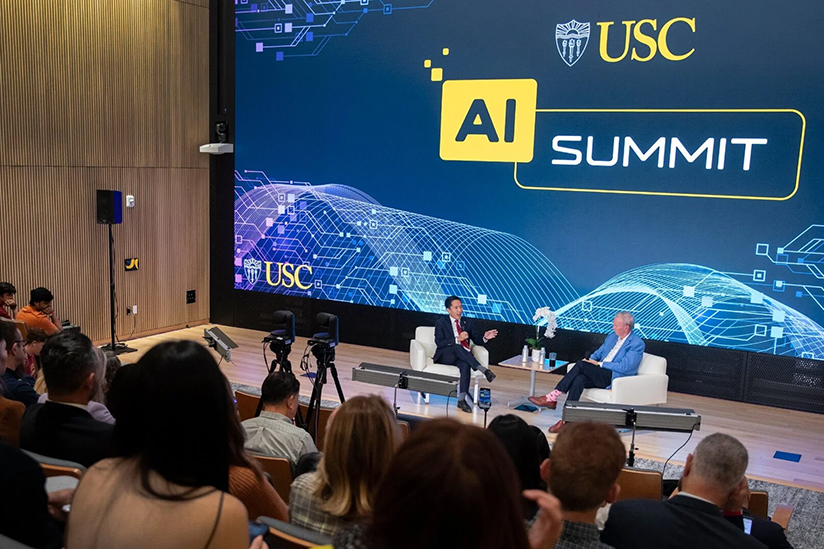
Pioneers in AI at USC
Explore decades of USC leadership in artificial intelligence research and innovation.
